
Welcome to Muddy Robots!
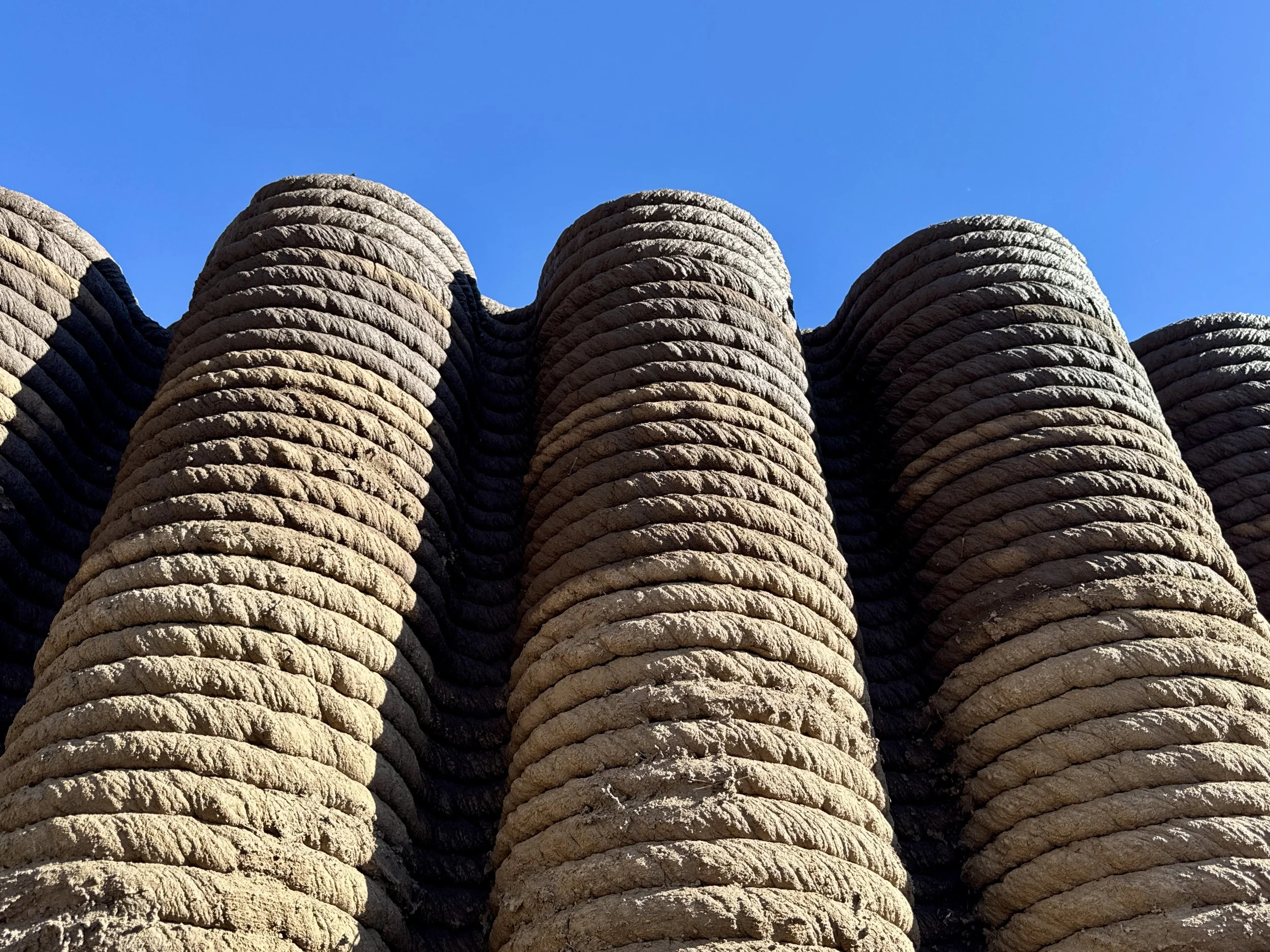
Adobe Oasis, Photo by Lance Gerber
Earth is the most sophisticated building material on the planet.
That's not a provocation. It's a statement that becomes more defensible the more closely you examine it. Earth has extraordinary thermal mass, allowing structures built from it to maintain comfortable interior temperatures without mechanical heating or cooling. It produces zero carbon dioxide emissions — not reduced emissions, zero — at a time when the built environment is responsible for 40% of annual global CO2. It is locally available almost everywhere on earth. It requires minimal embodied energy to process. And when a structure made from it reaches the end of its useful life, it returns to the ground it came from, leaving nothing behind that the land can't absorb.
Modern construction largely walked away from this material in the twentieth century, in favor of systems that are faster to assemble, easier to standardize, and far more profitable to manufacture and sell. What was lost in that exchange wasn't just a building technique. It was a way of understanding the relationship between architecture, place, and material intelligence that took millennia to develop.
For the past five years, Muddy Robots has been recovering that understanding — and combining it with something the builders of earthen structures throughout history didn't have access to: advanced robotic fabrication, computational design, and proprietary software that allows earth to be worked with a precision and at a scale that wasn't previously possible.
Today, we are officially a company.
The Work Came First
Muddy Robots did not begin with a business plan. It began with a question Ronald Rael asked in his 2008 book Earth Architecture: what would happen if 3D printing technology were applied to the world's oldest building material? That question became an obsession, then a research practice, then a body of built work that has been exhibited in museums and institutions around the world.
Over the past five years, what began as a presence on Instagram — a record of experiments, prototypes, material studies, and completed projects — became something more substantial: a proven set of methods, a refined design language, and a robotic construction system capable of producing architecture that is thermally efficient, structurally sound, and unmistakably beautiful.
The experiments were not a warm-up. They were the work. Every material test, every prototype, every completed installation advanced the knowledge that makes what comes next possible. We didn't spend five years preparing to build. We spent five years building — and learning, with each project, how to build better.
Three Founders
Muddy Robots is the product of three people whose careers have each, in different ways, been oriented toward the same questions: How do we build more responsibly? How do we use technology to expand what craft can do? How do we make architecture that is beautiful because of its material intelligence, not in spite of it?
Ronald Rael, Founder & Creative Director, is an architect, designer, author, and entrepreneur who has spent his career at the intersection of earth, technology, and architecture. He is the co-founder of Emerging Objects, the groundbreaking 3D printing innovation studio, and co-founder of FORUST, the world's first company to 3D print with wood. His work has been recognized with a Cooper Hewitt Smithsonian National Design Award for Digital Design. He holds the Eva Li Memorial Chair in Architecture and chairs the Department of Art Practice at UC Berkeley.
Virginia San Fratello, Founder & Design Operations Director, is an architect and interior designer whose work bridges traditional craft and advanced fabrication technologies. With more than twenty-five years of professional experience, she brings deep expertise in digital materiality, finishes, lighting, and the cultural role that materials play in shaping how we live and build. She is co-founder of Emerging Objects and FORUST, and her work has been collected by MoMA, SFMOMA, LACMA, and the Cooper Hewitt Smithsonian Design Museum.
Andrew Kudless, Founder & Technology Director, is a designer and researcher with two decades of work in robotic fabrication, parametric design, and material systems. He is the founder of Matsys, the award-winning design studio whose work lives in the permanent collections of SFMOMA, the Centre Pompidou, and the FRAC Centre. He is the Kendall Professor and Associate Dean for Research at the University of Houston's Hines College of Architecture & Design, where he directs the CRAFT Lab, one of the country's foremost environments for robotic construction research.
Together, these three bring the creative vision, material knowledge, fabrication technology, and design rigor to do something the construction industry has rarely attempted: build beautiful, large-scale architecture from the ground beneath it.
What's Coming
In one week, a Muddy Robots installation opens in a major museum. Later this summer, a larger architectural project completes. Several significant hospitality developments are currently underway.
Over the next two weeks, we'll be sharing the full story of this company — the projects, the technology, the people, and the work ahead. We invite you to follow along.
Muddy Robots is official. The foundation is built. Now we build on it.